
Is Your Child Hard to Understand? Here are 3 Simple Strategies to Try at Home!
Does your child have a hard time saying certain words clearly? Do you find yourself asking them to repeat themselves, only to have difficulty understanding them again?
If your child’s speech is difficult to understand, you’re not alone! Many parents notice that their child struggles to pronounce certain sounds or words, especially when talking quickly, telling a story, or communicating with people outside the family.
The good news? There are simple ways to support your child’s speech development at home without turning every conversation into a speech practice session.
As a pediatric Speech-Language Pathologist at Speechie in Spokane, I help children ages 3+ years improve their speech clarity so they can communicate confidently, be understood by others, and build meaningful connections with friends and family.
Let’s explore three simple speech therapy strategies you can start using at home today!
Why Is My Child Hard to Understand?
Children develop speech sounds at different rates. While some speech errors are a typical part of development, others may persist longer than expected or make it difficult for your child to communicate effectively.
You might notice that your child:
Says certain sounds incorrectly or leaves sounds out of words.
Replaces one sound with another, such as saying “tar” instead of “car.”
Gets frustrated when you or other people cannot understand what they are saying.
Repeats a word several times but still struggles to say it clearly.
Is easier for family members to understand than teachers, peers, or unfamiliar listeners.
These difficulties may be signs of a speech sound disorder, which can affect how a child produces individual sounds and/or uses them in words.
If your child is frequently difficult to understand, a speech evaluation can help determine which sounds they are struggling with, why those errors may be happening, and what type of support may help.
In the meantime, here are three simple strategies to try at home!
1. Let Your Child See Your Mouth When You Model Words
Have you ever asked your child to repeat a word, only to hear the same unclear production again?
Instead of immediately asking them to “say it again,” try showing them HOW to say the word.
Children can benefit from seeing how your mouth moves when you produce a sound. Watching your lips, tongue placement, and mouth movements provides a visual example of how a word is made.
How to try this at home
Get down to your child’s eye level so they can see your face.
Choose a word your child has difficulty saying.
Say the word naturally, then repeat it a little more slowly while keeping your mouth visible.
Give your child a chance to watch and listen before inviting them to try.
For example: If your child says “tar” instead of “car,” you can model “car” while allowing them to see your mouth as you say the word.
Keep it playful and relaxed! You can practice while playing with toys, reading books, getting dressed, or talking about your day.
Parent tip: You don't need to exaggerate every mouth movement or turn every word into a lesson. Simply making your face visible and providing a clear model can give your child another way to learn.
2. Say the Word Together Instead of Asking Your Child to Repeat It Alone
Sometimes, repeating a word independently is much harder than saying it with someone else.
When a child is learning a new speech sound, they may not yet know exactly how to move their mouth to produce it. Asking them to repeat a word over and over may not provide the information they need to make a change.
Instead, try saying the word at the same time!
How to try this at home
Choose a familiar word your child finds difficult.
Say the word slowly and clearly while your child says it with you.
Keep your face visible so your child can watch your mouth as you speak.
If it goes well, try the word again together during a fun activity.
For example: If your child has trouble saying “fish,” you could hold up a toy fish, look at your child, and say “fish” together.
This gives your child an opportunity to listen to your speech, watch your mouth, and coordinate their own speech movements with your model.
If your child still struggles, that's okay! You can model the word naturally and move on without making them repeat it until they get it right.
The goal is to help your child feel supported while learning—not frustrated or pressured.
3. Model Clear Speech During Everyday Activities
One of the easiest ways to support your child's speech development is to incorporate clear speech models into activities you already do together.
You don't need special equipment, worksheets, or hours of practice. Everyday routines offer plenty of opportunities to hear and practice words.
How to try this at home
Choose an activity your child enjoys, such as playing with cars, building with blocks, reading a favorite book, or preparing a snack.
As you play or interact, naturally emphasize words that contain sounds your child is learning.
For example:
Playing with cars: Model words like “car,” “go,” and “stop.”
Building with blocks: Model words like “build,” “big,” and “fall.”
Reading a book: Emphasize familiar words and name the pictures together.
Playing with animals: Model words like “cat,” “dog,” and “fish.”
If your child says a word unclearly, you can respond with a clear model rather than stopping the conversation to correct them.
For example:
Child: “I see a tat!”
Parent: “Yes! I see a cat, too!”
You have acknowledged what your child said while giving them a clear example of the word.
Remember: The goal isn't perfect speech during every interaction. It's to create positive opportunities for your child to hear clear speech models and participate in communication without feeling discouraged.
What If My Child Still Has Trouble Saying Words Clearly?
These strategies are a great starting point, BUT they aren't a substitute for individualized speech therapy when a child needs additional support.
If your child continues to struggle with certain sounds or is frequently difficult for others to understand, there may be more going on than simply needing extra practice.
For example, children with speech sound disorders may need help learning:
How to position their tongue, lips, or jaw to produce specific sounds.
How to hear and recognize the difference between two sounds.
How to coordinate the movements needed to produce a new sound.
How to use a newly learned sound in words, sentences, and everyday conversation.
The right approach depends on your child's individual speech patterns and needs. Simply asking a child to repeat a word more often doesn't always teach them how to produce it differently.
A Speech-Language Pathologist can assess your child's speech sound development, identify patterns of errors, and create an individualized treatment plan to build clearer, more confident communication.
You don't have to wait until your child starts school or becomes frustrated to seek help.
Pediatric Speech Therapy in Spokane, WA
At Speechie in Spokane, I specialize in helping children ages 3+ years who have difficulty producing speech sounds clearly and/or understanding how to use the sounds correctly in spoken language.
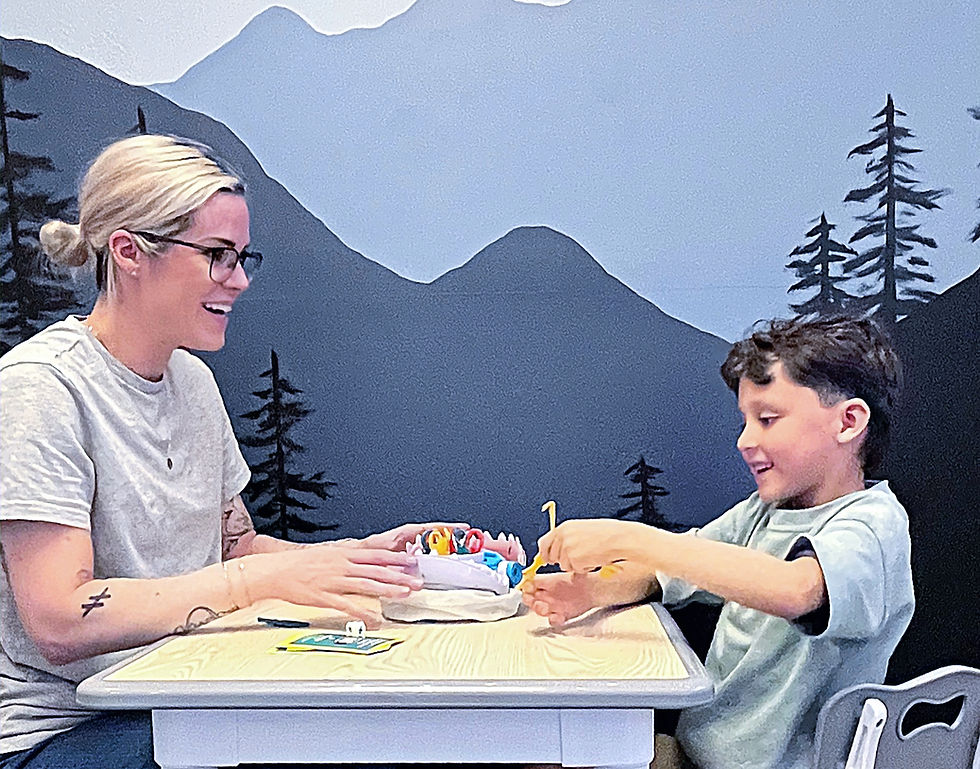
My approach is PLAY-BASED. That's right, our speech sessions are loaded with FUN! When children are having fun, they are more motivated to participate and engage in activities- and that is when we see the quickest most meaningful progress. Your child will be given the skills they need to improve their speech- not simply asked them to repeat words over and over.
Through individualized, play-based speech therapy, children can work toward clearer speech while building the confidence to communicate with the people around them.
Whether your child struggles with sounds like /R/, /S/, /L/, /K/, or /G/, leaves sounds out of words, or is difficult for others to understand, I can help you understand what may be happening and what steps to take next.
My goal is simple: Clear speech. Confident kids.
Wondering If Your Child's Speech Is on Track?
If you're a parent in Spokane, Washington, and you've been wondering whether your child's speech development is where it should be, let's talk!
You don't need to figure it out alone, and you don't have to wait and hope your child will grow out of their speech errors.
Free speech screenings are available at Speechie in Spokane!
A screening is a simple first step to help determine whether a more comprehensive speech-language evaluation may be beneficial. It does not replace a formal speech evaluation or provide a diagnosis.
If you have concerns about your child's speech clarity, I'd love to help you understand your options.
Ready to take the next step?
Reach out to ask about a free speech screening or to schedule a speech evaluation for your child today.
Let's help your child speak clearly, connect with others, and communicate with confidence!
Speechie in Spokane LLC | Pediatric Speech Therapy in Spokane, Washington
Clear speech. Confident kids.

Comments